Before the Printed Map: How Place Names Marked the Landscape
Place names mark landscape features and locations through local speech; learn how to read those clues without treating a name as a complete history.
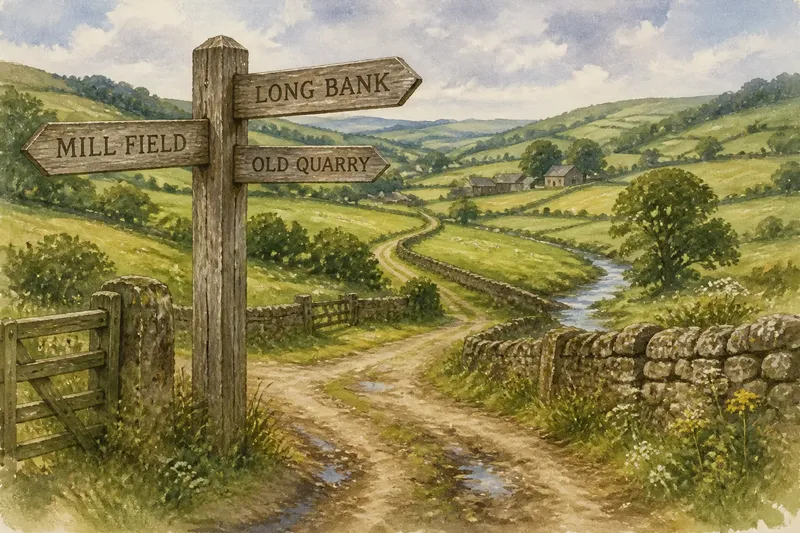
A place name can point you towards a feature before you can see it. On a parish lane, “Mill Field” may distinguish a familiar patch of ground from the next one, while “Long Bank” can help a neighbour give directions without unfolding a map. Before printed maps were common, place names worked as practical spoken labels, shared and adjusted by the people who used them.
Reading place names in the landscape is useful, but a name is a clue, not a full historical record. Its value lies in the distinction it makes: this hollow rather than that one, the upper farm rather than the lower, the crossing by the old track rather than the bend beyond it.
Names gave nearby features separate identities
People who lived and worked in a small area needed to distinguish features that looked much alike on a broad map. A pair of fields might both be pasture, but one was “the wet meadow” and the other “the meadow by the ash”. A stream could have a local name different from the village’s, helping callers specify which stretch they meant.
Such names were often compact descriptions. “High” and “Low” could separate adjoining ground; “Upper” and “Lower” could distinguish farms or parts of a settlement. Names involving a gate, bridge, spring or ford could identify a useful meeting point. They did not need to describe the whole landscape. They only had to work in conversation among people who knew the area.
That local usefulness also explains why one feature might have more than one name. A farmer, a carrier and a resident of the nearest village might refer to the same lane junction in different ways, each name fitting a particular route or habit of speech.
Landscape words often describe what can be noticed
Many place names preserve ordinary observations about the ground. A name containing “combe” or “coombe” may point to a valley or hollow in some parts of Britain; “beck” and “burn” are regional words for a stream. “Mere” can refer to a lake or pool, though usage varies. “Bank” may describe a slope or raised edge, rather than a boundary line.
These words are helpful when they fit what is visible, but they are not a universal key. The same word can carry different local meanings, and spellings may have shifted as names were written down by people unfamiliar with local pronunciation. Treat a landscape term as a prompt to look around, not a precise technical label.
Notice the scale, too. A name may refer to a whole slope, a small spring at its foot or a field beside it. The feature that gave rise to a name need not be the most prominent one now. Drainage, planting, building and changes in land use can alter what a walker sees while the old label persists.
Spoken directions relied on shared landmarks
Names helped people pass directions from one person to another. “Turn at the old quarry” or “take the track past the common” is useful when both people know which quarry or common is meant. In this way, place names linked speech to movement: they marked a turn, a crossing, a useful stopping point or the edge of a familiar area.
Imagine a visitor asking for a farm on the far side of a parish. A resident might name a bridge, then a field entrance, then the rise beyond it. Each label narrows the route through known features. The visitor could then hear those names repeated by another local person, even if neither speaker had access to a printed map.
That does not mean every name was designed for travellers. Some belonged mainly to work on the land, such as names for fields, grazing areas or woodland compartments. A name that seems obscure to a passer-by may have been perfectly clear to someone deciding where to bring livestock or collect timber.
Written forms record a name, not its whole story
When a spoken name appears in a document or on a map, it has passed through a choice of spelling. A clerk might write down what they heard; a map-maker might prefer a familiar spelling; later signs might adopt a form that differs from local speech. A name can therefore look more settled on paper than it was in everyday use.
For a local enquiry, compare the map label with how people pronounce it, and notice whether nearby names share a word or sound. Older maps, parish records and local field names can offer further clues, but each captures a particular use or spelling. None should be treated as a complete account of how a name began or changed.
It is not worth forcing a neat origin story from a name simply because its words look familiar. A spelling may resemble a modern word by coincidence, or a local form may have been reshaped over time. The sensible reading is often modest: this name seems to refer to a feature, direction or distinction, while its precise history remains uncertain.
What can a place name tell you?
Does a name identify a landscape feature?
It can suggest one, especially when a familiar local term matches a visible hollow, stream or slope. Check the terrain and nearby names, but allow for changes in the feature and variation in the word’s local meaning.
Can one place have more than one name?
Yes. Different households, occupations or neighbouring settlements may use different names for the same spot. Each may reflect a distinct route, task or habit of speech rather than a disagreement about the place itself.
Does an old-sounding name prove a particular origin?
No. A name’s sound or spelling alone cannot establish when it began, who coined it or exactly what it meant. Use maps and local records as clues, and keep the conclusion narrower than the evidence.
Why might a map spelling differ from local pronunciation?
Written forms can preserve a recorder’s interpretation rather than the sound used in conversation. Local speech may also change while a printed label remains in place.
Read names as useful local clues
On a walk, jot down a name beside the feature it appears to distinguish: a lane bend, a spring, a field entrance or a cluster of houses. Then compare it with the ground and with nearby names. This simple practice keeps observation ahead of speculation.
Place names mark landscape by making local distinctions easy to share. A name may suggest what people noticed, where they travelled or how they divided familiar ground, but it does not preserve every detail. Read it alongside the terrain and local speech, and let uncertainty remain where the evidence ends.